
One of my most favorite scenes of all time in any given movie was when a woman named Eowyn came into battle at a time and era when women were not allowed to go into battle, disguised as a knight, with her face covered by a helmet, all geared up with complete armor and sword. Then it came that she had to face the leader of the enemy troops who was called the Witch-King, and he said to her, “You fool! No man could kill me!” Then, taking off her helmet, she fiercely and without fear told him, “I am no man!” then lunged her sword into his head, killing him.
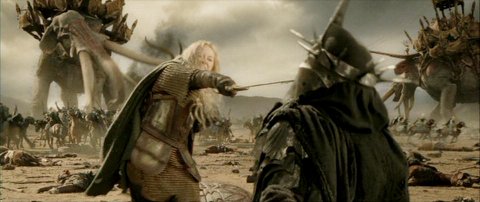
When she said “I am no man”, she of course meant that she is a woman. But if we take out this sentence out of context, if we only have read it somewhere and did not know what was going on, it could also provide us with other different meanings. “I am no man” could also mean that the one who said it is “not human” and if “not human” then, possibly “sub-human”, among many other meanings.
If we take this scene and position ourselves in Eowyn’s standpoint, and the enemy of our souls, Satan, and tell him “I am no man”, we could take it to mean that we are no ordinary men. If you are in Christ, you ought to be wearing the whole armor of God. Paul told the church in Ephesus,
“Finally,brethren, be strong in the Lord and the power of His might, take the helmet of salvation, and the sword of the Spirit, which is the word of God”.
(Ephesians 6:17)
If we take it that we are Eowyn and Eowyn is wearing the armor of God, which is the mark of those who are in Christ Jesus, the helmet that she would then be wearing which keeps others from identifying her as a woman since it was covering her face and hair is the helmet of salvation. She is wearing the salvation of the Lord over her head so the enemy does not see her as a woman who is seen as the physically weaker gender, but a man. If the enemy was not the Witch-King but Satan, Satan would see us, Eowyn, as a mere man, but the salvation of God is our protection and it stamps a mark upon our heads saying, “No, this is not merely human. This is not merely man. This man is saved by the grace of God through the power of the blood of Jesus Christ.” In the same way, the sword which Eowyn thrusts upon her enemy, if she is to be us, is no ordinary sword. That sword kills. For it is not but a sword forged by a bladesmith. It has a great power from within, for it is the the Sword of the Spirit. It is the Word of God.
If we are Eowyn and walk into this daily battle called life, wearing the whole armor of God, why then are we walking away defeated? We walk with heads down and swords not drawn when the bible clearly tells us that we should put on the complete armor of God. We did not even mention the belt of truth, the breastplate of righteousness, the shield of faith, the combat boots of peace. But by thinking even just of the helmet and the sword, we know that we have the Spirit of God with us, if we carry the Word of God daily. We are protected by the helmet of God´s salvation so even when the enemy sees us as mere men which he can devour and attack any time he wanted to, the reality is that, we are not mere men. We are the children of God!
A lot of us are walking into battle and facing the enemy of our souls with sullen and fearful faces. Why is that so?
Firstly, because we have not put on the helmet of salvation which bears our true identity from within and that is – that we are sons and daughters of the Most High God. We are walking into battle bearing our identity as mere men, not taking claim of and owning our true identity as God’s children saved by His grace.
Secondly, because we are not carrying the sword of the Spirit which is the Word of God, with us. How do you expect to win a battle without a weapon? Yes, we are marked by God’s saving power but the enemy prowls ready to attack us at any given moment. Without our weapon, we would fall as easy prey.
If you do not wear your helmet and do not carry your sword, where would that bring you? That would bring you to feeling not enough, that you do not matter, that you are too much of all the negative stuff and not enough of the positive stuff to keep life going, and that you are not a good enough Christian to be used of by God. Where do these all end? They end in self-condemnation. Self-loathing. The grandest pity party.
They end in an endless cycle of guilt, and shame, and feelings of worthlessness.
However, despite that, one of my favorite passages in all of Paul’s letters, Romans 8, has an answer to all that endless cycle. In fact, it has become my sword in upkeep of the daily battles of life.
“There is therefore now no condemnation to those who are in Christ Jesus, who do not walk according to the flesh, but according to the Spirit. 2 For the law of the Spirit of life in Christ Jesus has made me free from the law of sin and death.”
(Romans 8:1-2)
No condemnation.
The word condemnation in the Greek, as it is written in the Koine is the word “katakrima”, which means the punishment following a sentence. If you are declared guilty of a crime, you would be sentenced to a certain term of punishment in accordance with the law. Your sentence does not have anything to do with whether you feel guilty or not. It means what you are punishable with.
There is therefore now no condemnation – that is, “katakrima“, meaning, no sentence or punishment -to those who are in Christ Jesus, who do not walk according to the flesh, but according to the Spirit.
In order for us to be free from death sentence or life imprisonment, Jesus Christ, the Son of God, took our punishment for us. He gave up His life so that we would not be sentenced to death, so that we would not serve life imprisonment. He gave His life so that we may have life.
In the Old Testament, there is a law which can be summed up as “An eye for an eye, a tooth for a tooth.” Jesus Christ fulfilled this Old Testament Law in the New Testament – “Life for life”.
HIS LIFE, FOR YOUR LIFE.
When Jesus was brought before Pilate, it was the feast of the Passover. In Mark’s account of this trial before Pilate, in chapter 15:6-15, we can read how, when the crowd was asked what should be done with Jesus, they shouted, “Crucify him!” and to release a rebel named Barabbas as was the custom during the feast.
So, here is a man named Barabbas, sentenced for the crime of insurrection and murder which entailed death penalty by crucifixion. But as it was a custom to release one prisoner during the Passover Feast, finding no guilt in Jesus, hoping that Jesus would be released as he had sensed that Jesus was brought for trial only because he was envied by the chief priests who turned him over, Pilate asked the crowd to decide between Jesus and Barabbas.
Therefore, when they had gathered together, Pilate said to them, “Whom do you want me to release to you? Barabbas, or Jesus who is called Christ?” (Matthew 27:17)
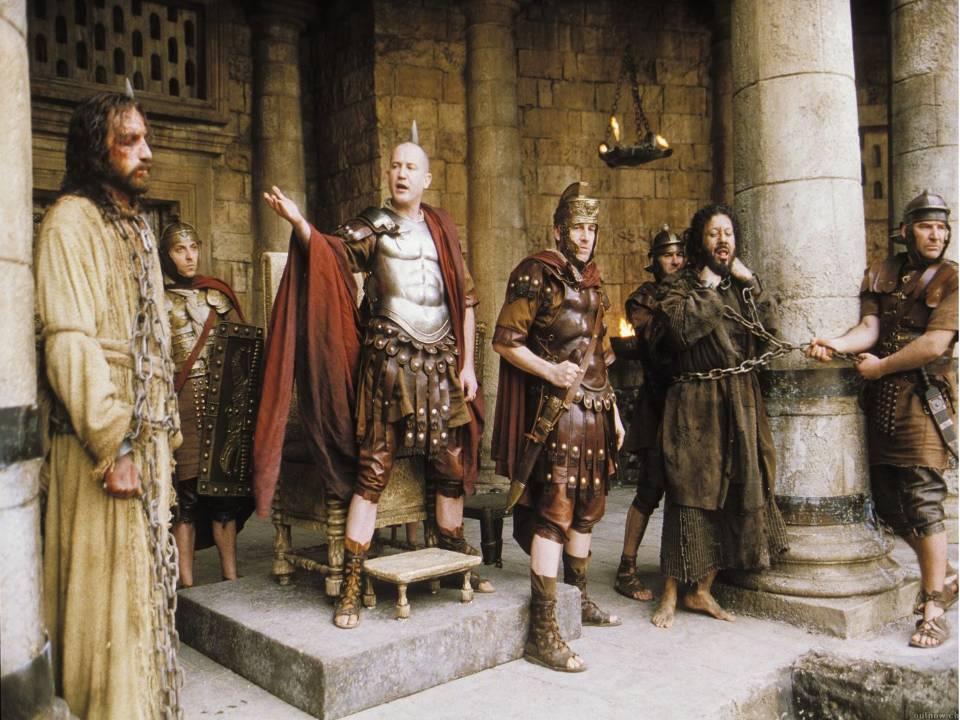
The crowd chose Barabbas. Thus, Jesus was punished. Barabbas was pardoned. Jesus was crucified. Barabbas was discharged. Jesus died. Barabbas lived.
Jesus’ life, for Barabbas’ life.
Barabbas or Jesus?
You know what? You and I are Barabbas. We all are Barabbas. We all are sinners. We all are deserving of a sentence in accordance to our ways of life. But we have been pardoned. We have been set free. We have been given another chance. We have been given life. A new shot at life.
His life,
for our life.
Why then, are you still walking in the daily battle called life, in condemnation?
Father God has pardoned you. Jesus has set you free. You have been given life.
Walk like it. Act like it. Live like it.
Chin and heads up, warrior. You are no mere man!
 Simply Ellaine