
The current covid-19 pandemic has revolutionized the ways we interact socially. The salt and pepper of meet-ups outside of one’s household before the pandemic restrictions were set into place – touches and hugs, are now a thing of the past. What was once normal, has now become the “abnormal”.
This reminds me of King Midas. The king with the golden touch. The king who has asked the gods to enable him to have all the riches he wanted. Therefore, they gave him the ability to turn anything and everything he touched into gold.
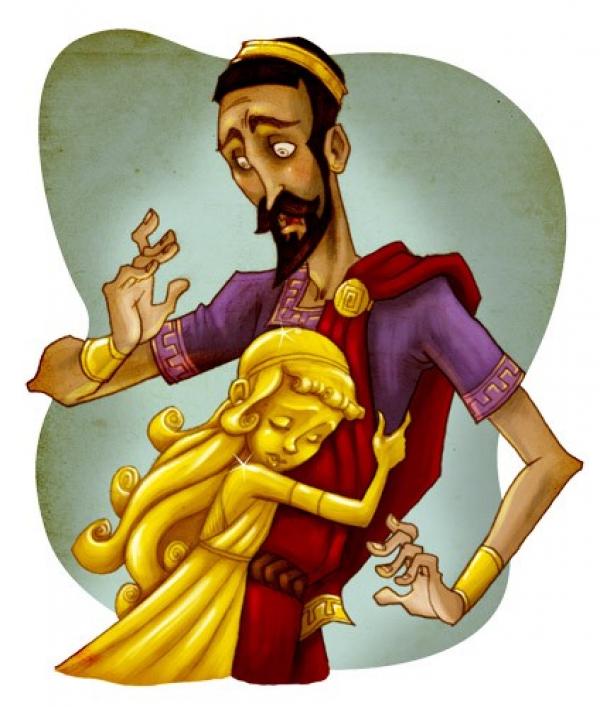
Now, I have given away the ending of the story, even if you have never heard of it before. Sorry.
I am not telling you this to help prevent you from sprinkling the social salt and pepper. Instead, I am doing so because I know of another kind of touch. An abnormal kind of touch. A touch that rises beyond what is normal. A touch where we can see the power of the “abnormal”.
One touch. A life changed forever.
12 While Jesus was in one of the towns, a man came along who was covered with leprosy. When he saw Jesus, he fell with his face to the ground and begged him, “Lord, if you are willing, you can make me clean.”
13 Jesus reached out his hand and touched the man. “I am willing,” he said. “Be clean!” And immediately the leprosy left him.
(Luke 5: 12-13)
Luke, who wrote this passage, was a physician. That is why, in the Greek text, one can see the abundant use of medical terminology in his writings. Of the three gospels accounts where we can find this narrative, it was only in his account that it was written that the man has an advanced case of the disease as it was described: “covered with leprosy”. The other two writers, Matthew and Mark, did not take note of this.
Leprosy destroys the nerve endings, so lepers would often unknowingly damage their fingers, toes and noses. Patients with leprosy experience disfigurement of the skin and bones, and twisting of the limbs. This man has an advanced stage of leprosy. Hence, he undoubtedly has facial features in the likes of

So, we have here an outcast of the society, a man repulsed by many. Nobody wanted him. Just imagine the amount of rejection he experienced. He might be someone who actually felt so unloved. What could be worse than the leper’s situation? He was unwanted. At a time when no covid-19 pandemic restrictions govern social behavior, nobody wanted to get close to him. However, what´s noteworthy is that, he exemplified great hope. He knew that Jesus can heal! He approached Jesus knowing that Jesus could change his life.
This leper, in more ways than one, is us. All of us have been sick at a certain point in our lives – physically or emotionally. We may have experienced being rejected and unloved. We may have felt like an outcast in certain social circles where we do not feel welcome or fit. But in the same way, like the leper, we should never lose hope – the hope that no matter what happens, our God is able to make the difference.
In the account written by Mark, we can read something written neither by Luke nor Matthew:
“ Jesus was indignant. He reached out his hand and touched the man. “I am willing,” he said. “Be clean!”
(Mark 1:41)
Jesus was indignant. Indignant means to be displeased over mistreatment, which equates to being full of compassion. Jesus was moved by his love. Therefore, he touched the leper with a divine touch. In touching the man, Jesus subjected himself to three things:
Breaking the law
Defying the norm
Contracting the disease himself
Remember, this is a leper that Jesus is dealing with in this story. In many occasions, Jesus heals just by pronouncing the person as healed. He’ll say, “Be healed!” or “You are healed!” But here, he reached out his hand and touched the man.
Jesus broke the law and he defied the norm. Jesus being human meant he has the full attributes of a human being. He had human needs. He became hungry that was why he looked for figs but when he found none, cursed the fig tree. He became tired that was why he slept on the boat and his disciples panicked because he was sleeping like a baby even though they feared for their lives because of the storm. He expressed emotions by being angry when the temple merchants turned the temple into a market place. He cried when his good friend Lazarus died. He was tempted although he didn’t give in by standing firm through the scriptures. If he needed food and rest, if he experienced anger and anguish, if he had been tempted, it meant he can also contract disease, right? Yes, after all, he died! He experienced physical pain on the cross and died. He was human. He could get sick too! But even with the knowledge that he could get sick, still, he touched the leper.
He made this nobody, rejected, unloved leper into somebody by touching him and reaching out to him in love and compassion!
He even did not just stop at reaching out his hand to the leper. He even said, “I am willing!” He was willing – meaning, he did it with love. He did it with a cheerful heart.
It is easy to reach out to people we love or people that are easy to love. The challenge comes with people whom we do not know will respond to that love – these are the difficult people, the people with attitude, the people that are hard to love in human standards. But just like Jesus did with the leper, would you be willing to stretch out your hand in love to them as well? Are we willing to get our hands soiled and dirty in messy and difficult situations just so we can reach out to others?
Jesus exemplified abnormal Christianity. Abnormal Christianity means loving with compassion. It means rising up from beyond “normal” to the “abnormal” by stretching out our hand to our neighbor saying, “I am extending God´s touch to you.”
What to Jesus was normal, what to us as Christians should be normal, has now become abnormal due to a change of how we perceive, view and act upon things. Sadly, what was meant to be normal has risen to the likes of that which is not. However, if our lives are to be all about following Jesus and his example, we should rise above what has become normal to that which is not, to that which we sadly no longer are. Let us make the normal abnormal in order to revert back to the old school normalcy that Jesus actually taught to do, by his example.
Social distancing measures might be preventing us from actually sprinkling our interactions with the salt and pepper of society. But even when physical touch is not possible, a touch of the heart could not be prevented by any pandemic. In fact, it should do otherwise.
That friend or colleague you haven’t seen nor heard of for a long time due to this pandemic? They might just be waiting for a touch of your voice, or smile via video chat, or even a sincere hello. In these abnormal times, let us live up to our abnormal Christianity.
(Cliparts used from clipart.com)
 Simply Ellaine